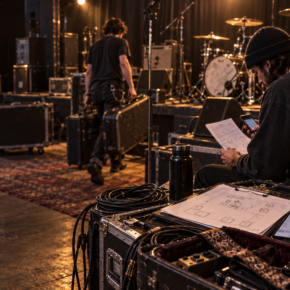


Are you IN a band? Or are you Building a Band?
That’s a question I have found myself asking working bands more and more lately, and it is not whether the band can play well… Most of the bands I deal with can play. That is usually the easy part. The question is whether or not they’re actually operating as a band… or whether four or five musicians are sharing a stage while ONE person somewhere in the middle of it is trying to run a small business by himself.
Those are two very different things.
I am not talking about making every member do the same job. But if a band is going to be working together as a cohesive, well… BAND – Each member should see how their individual talents aside from just showing up and playing the music, can benefit the team as a whole. Different people have different strengths, and a smart band utilizes every strength to propel themselves forward, and lighten the load across the board.
You see, there’s a difference between playing in a band and helping build a band. If everybody expects to share the gigs, the money, the recognition and the opportunities, then somebody ought to be able to explain what each person contributes to making those things happen.
The work nobody sees
Here is the version I keep seeing. One person books the shows, answers the buyers, keeps the calendar straight, sends the promo material, updates the website, posts the dates, owns the PA, stores the PA, loads the PA and somehow also knows where that one stupid adapter is that everybody swears was in the cable box last week.
Then he gets to the venue early, loads in, gets the stage together, handles soundcheck and solves whatever little disaster showed up this time.
Forty-five minutes before downbeat, another member walks through the door carrying a guitar.
“Where do you want me?”
Now, if you have been around bands for any length of time, somebody just popped into your head. Keep the name to yourself. The point is not to roast Guitar Guy. The point is that both musicians may honestly believe they are equally committed to the band because both of them learned the material, showed up and played the same three-hour show.
Musically, maybe they are. Operationally, not necessarily.
That is where the resentment starts. One person is thinking, “I do everything around here,” while everybody else is thinking, “Nobody ever asked me to do anything.” And the uncomfortable part is that sometimes both sides are telling the truth.
Sometimes the bandleader built the problem too
Bandleaders are not automatically right just because they are tired.
I have watched people take control of every part of a band because, at the beginning, it was easier. They already knew the club owner, so they booked the first show. They owned the PA, so they handled production. They knew how to build the website, so they did that too. Then every new job simply landed on the same desk because that was where everything had always landed.
Five years later, that person is burned out and furious that nobody else takes initiative.
Fair enough… but there is another question that has to be asked: Did you ever give anybody else something to own?
Did you ever say, “I need you to take this off my plate”? Did you explain what needed to happen? Did you let somebody do it differently than you would have done it? Or did you create a system where every decision has to come through you and then get mad because every decision has to come through you?
You cannot keep every key to the building and then complain nobody else opens the doors.
Equal commitment does not mean identical duties
This is the part I think bands get wrong when they finally have the conversation. Somebody says, “Everybody needs to contribute,” and suddenly it sounds like every member needs to become a booking agent, social-media manager, roadie, merch seller and web developer.
No.
One member may be good at social media. Let that person own it. Another may work in sales and have no problem walking into a venue, introducing himself and starting a relationship. Somebody else may be the equipment nerd who can look at a stage and immediately know what needs to go where. Another member may actually enjoy organizing merch, inventory and money.
Different jobs. Same band.
The issue is not whether everybody spends the exact same number of minutes doing band business every week. That is nearly impossible to measure and even harder to make useful. The issue is whether everybody contributes to building the thing everybody expects to benefit from.
What do we rely on you for?
That is the question I would put on the table at the next band meeting.
Not, “What instrument do you play?” We know that.
Not, “How long have you been with the band?” That is not the question either.
What do we rely on you for?
If the answer is booking, great. If it is production, promotion, merch, networking, content, stage management, keeping the calendar from becoming a train wreck, whatever… great. It does not have to be glamorous. Most of the important work around a band is not glamorous.
What matters is that the answer exists.
And what if somebody really is “just the player”?
That can work too. Plenty of successful bands operate with one person owning the business and other musicians working as hired players or sidemen. There is nothing wrong with that arrangement if everybody understands the arrangement.
The trouble starts when people want the authority and benefits of partnership while treating every responsibility outside the stage like somebody else’s job.
If you are partners, act like partners. If you are hired players, know the deal. If you are somewhere in between, then define what “somewhere in between” actually means before money, authority or resentment defines it for you.
You do not need a corporate retreat to solve this. Sit down after rehearsal. Make a list of what actually has to happen for the band to function. Who is doing those things now? Who is good at what? What is getting ignored? What is wearing somebody out? What could somebody else take over?
You may discover that one person really has been carrying too much. You may also discover the rest of the band genuinely did not know.
That is a fixable problem.
So before the next conversation about where the band ought to be six months from now, ask a simpler question:
Besides playing your instrument, what are you personally doing to help build the band?
You do not have to have the same answer as everybody else.
But if you are serious about building this thing together, you ought to have an answer.
Next in Band Rescue: Your Bandleader Isn’t Your Bank